A job marked “in progress” can still have no next step. How teams keep outstanding service jobs visible, owned and moving, instead of quietly ageing on the board.
It is Friday afternoon, and a warehouse supervisor is on the phone about a reach truck that has been standing since Tuesday.
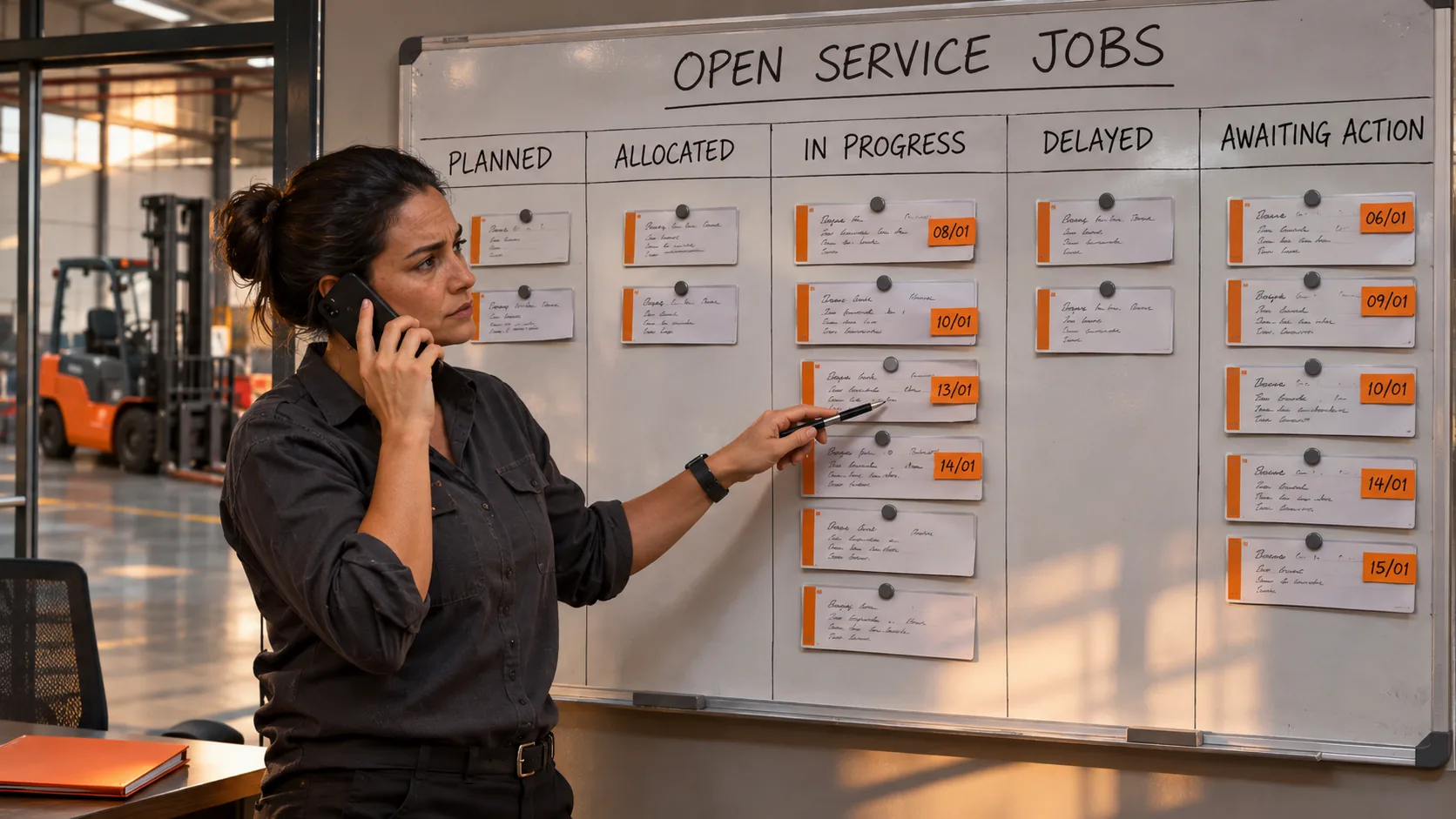
The service coordinator looks at the board. The job is still there, marked “in progress”. A technician was on site on Wednesday, left a quotation and has been on other breakdowns ever since. There is no note about a part, an approval or a return visit. There is only the original job, sitting quietly among a dozen others.
The coordinator tells the customer, quite honestly, that someone is looking into it. That is not a status the customer can plan a shift around.
Open jobs have a habit of going quiet
Most outstanding service jobs do not vanish. They simply stop being discussed. The urgent ones stay on the morning call. The rest drift into a holding pattern: awaiting a part, awaiting approval, awaiting access to the machine or awaiting a second visit that was never booked.
Each of those reasons is real. The trouble starts when they all look the same on the board. “In progress” covers a job being worked on this morning and a job that has not moved since last week. After a few days, the team is still busy, the customer is still waiting and nobody can say, in one sentence, what happens next.
A status only helps if everyone uses the same words
Service teams already have statuses. The problem is that the words often mean different things to the person who set them, the person reading the board and the customer asking for an update.
See how FMC keeps every asset, job and record connected.
Book a demoIt is worth agreeing a short, shared list and sticking to it. Planned, allocated, in progress, delayed, awaiting action and completed will cover almost every forklift job, provided each one has a clear definition. “Awaiting action” should say what the action is and who owes it. “In progress” should mean a technician is actively working the job, not that it has not been closed yet.
“Pending”, “with the technician” and “someone is looking into it” feel helpful in the moment. They are not statuses. They are postponements.
Every open job still needs an owner and a next step
A job can be waiting for something without being ownerless. A quotation sitting with a customer still needs someone in the service office to notice when the answer comes back, or when it does not. A part on order still needs someone to match it to the job when it arrives, and to book the return visit.
When that ownership is missing, outstanding work ages for quiet reasons. The part arrives and sits on a shelf because the job was no longer on today’s list. The customer approved the work on Thursday and nobody saw the message until Monday. The technician finished the diagnosis and assumed the office would take it from there.
The next step does not have to be the final repair. It has to be the next useful action, with a name against it. Once that habit is in place, a daily look at open jobs becomes a conversation about movement, not a search for what went missing.
Age tells you more than a simple count
A list of thirty open jobs sounds busy. It does not tell you whether the work is under control. Three jobs open since yesterday are normal in a field service operation. Three that have been open for a fortnight are a different problem, even if the total number has not changed.
Looking at outstanding service jobs by age, and by why they are still open, usually changes the conversation. Some are waiting on the customer. Some are waiting on a part. Some are waiting on a technician who has been pulled onto breakdowns. Some have simply not been touched. Each of those needs a different response, and none of them is fixed by adding another column called “priority”.
Review the oldest jobs first. The newest ones already have attention. The oldest ones are the ones customers have stopped believing will move.
Customers feel the jobs that linger
Inside the service operation, an open job is a line on a board. On the customer’s floor, it is a machine that is still standing, a workaround that is getting tiring and a question that has been asked twice already.
People will tolerate a wait when they know what they are waiting for. They lose patience when the only update is that the job is still in progress. That is not a complaint about effort. It is a complaint about silence.
This is why outstanding work should be visible to the people who need to see it, not only to the coordinator who holds the board. The customer does not need every internal note. They do need a current status, an owner and a realistic next step. When that is easy to find, the Friday afternoon phone call becomes shorter, and often unnecessary.
Where FMC keeps outstanding work in view
FMC Service Management gives authorised teams a clearer way to organise planned maintenance, breakdowns, repairs and follow-up work. Every service event remains visible from the moment it is raised until its outcome is recorded, including which jobs are planned, allocated, in progress, delayed, awaiting action or completed.
That keeps planned and reactive work in view throughout their journey, so teams can identify outstanding actions, follow progress and keep a dependable record of the final outcome. A service request should never disappear into an email thread or a WhatsApp group, and “someone is looking into it” is not a service status.
For service providers, the same view shows what customers are requesting, what work is outstanding and where jobs are delayed. The FMC Customer Portal then gives authorised customers a way to follow job progress, so they do not have to chase an update that already exists.
Software can keep the list honest. Closing the jobs is still a people decision.
A practical starting point
You do not need a new reporting project to get outstanding work under control. Start with the jobs that are already open:
- Agree a short list of statuses and write down what each one means
- Add an owner and a next step to every job that is not completed
- Once a day, review the jobs that have not moved, oldest first
- Separate work waiting on a customer, a part, a technician or no next step at all
- Tell the customer the next step, not only that the job is still open
The board will not be perfect after one week. It will, however, show movement, which is the only thing an open job is really for.
Back on Friday afternoon, the coordinator would still take the call. She would also be able to say that the quotation is with the site manager, a follow-up is booked for Monday and the truck is first on the list. That is a status a warehouse can work with.
“Someone is looking into it” is not a service status. The next action is.
Want this level of visibility across your fleet?
Book a demo