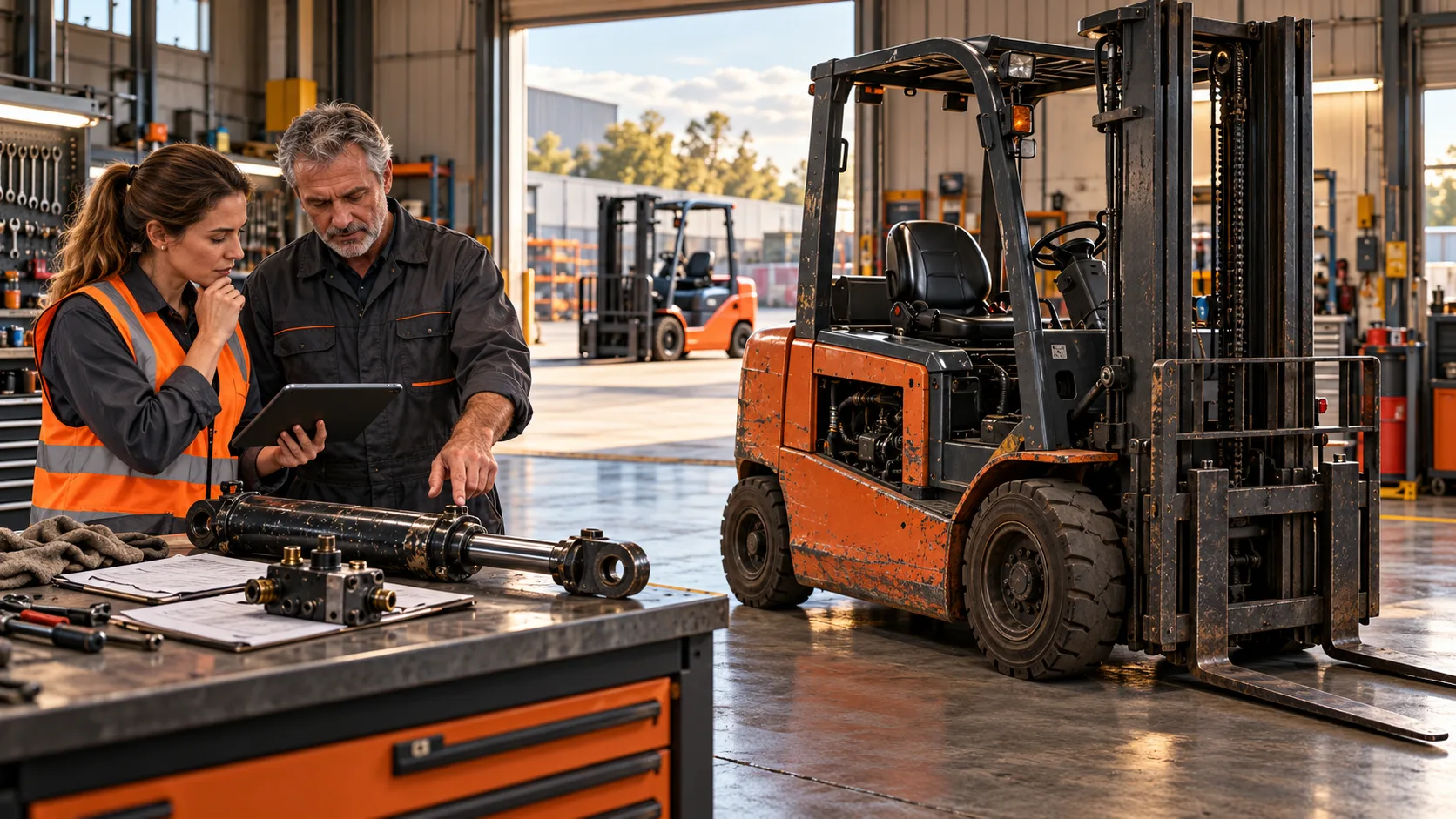
The quotation lands on the operations manager’s desk on a Tuesday afternoon. A new mast chain, two hydraulic cylinders and a reconditioned control valve for truck 07. It is the third substantial repair on that machine this year, and the workshop wants an approval number by tomorrow morning.
The manager asks a simple question: what has truck 07 cost us so far? Finance can say what the business paid the service provider last year, in total. The workshop can find most of the job cards. The hire unit that covered the truck’s last breakdown sits on a different invoice under a different cost centre.
By the time anyone has an answer, the repair has been approved. It usually is. Approving the repair always feels like the cheaper decision on the day.
The purchase price is the number everyone remembers
Most businesses know exactly what a forklift cost to buy. It is on the asset register, the depreciation schedule and probably an email somewhere with a signed quotation attached.
What they know far less clearly is what the machine has cost since. Planned services, breakdown repairs, parts, call-out fees, tyres, battery work, inspections and the hire unit brought in while it stood idle all add up over the years. Spread across monthly invoices and several suppliers, those costs rarely meet in one place.
So the original purchase price becomes the number people remember, and the ongoing cost of ownership becomes the number nobody can quite produce. That is backwards. Over the working life of a machine, what it costs to keep running often matters more than what it cost to acquire.
Why repair decisions get made one invoice at a time
Each repair quotation arrives on its own. Judged alone, almost every one looks reasonable. A modest sum to get a truck back to work is easy to justify when the alternative is a capital request, a procurement process and a delivery lead time.
The difficulty is that repair decisions are made one invoice at a time, while replacement decisions need the whole history. Without that history, the business keeps approving sensible repairs on a machine that stopped being sensible some time ago.
There is a softer cost too. The operator who no longer trusts truck 07 starts working around it. The shift supervisor quietly plans for it to be down. None of that appears on an invoice, but it shows up in the day’s output.
What belongs in the cost of a machine
Forklift cost of ownership only helps if everyone means the same thing by it. Measured machine by machine, a practical definition includes:
- planned services and inspections
- breakdown repairs and corrective work
- parts, tyres and consumables fitted to that machine
- call-out and travel charges linked to its jobs
- battery and charger work where they are tied to that truck
- hire or replacement units brought in while it was out of action
Downtime itself is harder to price, and there is no need to invent a figure for it. Recording how often and how long a machine was unavailable is usually enough to make the point in a management meeting.
The key is that every cost is recorded against the specific machine, not only against a supplier, a site or a month. A cost that cannot be tied to an asset cannot help anyone decide what to do with that asset.
Repair, rent or replace: three honest questions
When a large repair quotation arrives, the decision becomes clearer if the same three questions are asked every time.
First, is this repair part of a pattern? A single major repair on an otherwise reliable machine is normal wear. The third significant failure in a year, or the same fault returning after each fix, is a different conversation.
Second, is the machine still right for the work? Operations change. A truck bought for one shift may now be running three, or a counterbalance unit may be working in aisles that suit a reach truck better. Sometimes the right answer is not a better repair but a different machine.
Third, would renting cover the need better? For seasonal peaks, short contracts or uncertain volumes, a rental unit with clear terms can be more sensible than keeping an ageing owned machine alive for a few extra months.
None of these questions has a universal answer. They do all depend on the same thing: a reliable history of what each machine has done and what it has cost.
Make the history easy to see before the quotation arrives
The worst time to build a cost history is the afternoon a repair needs approving. The best time is continuously, as each service, repair and part is recorded against the machine.
When that happens, the replacement conversation changes. Instead of a gut feeling that truck 07 “is always in the workshop”, the manager can see its service events, repair costs and downtime alongside comparable machines. Finance gets figures it can check. The service provider gets a fair hearing, because the record shows what was done and why.
It also makes budgeting less of a guessing game. Machines that are steadily climbing in cost can be flagged for replacement planning a year early, rather than discovered in the middle of a breakdown.
Where FMC supports cost per machine decisions
FMC connects each machine to its service, repair and cost history in one record. Through FMC Asset Management, every asset has a central record and lifecycle history that can guide maintenance and replacement planning.
FMC Dashboards & Reporting lets authorised users review recorded service, repair and parts costs across individual assets, sites or selected periods, and present higher-level information to support fleet, supplier and replacement decisions. For fleet customers, that brings assets, service activity, suppliers, compliance and costs into one view across every site.
FMC makes the numbers visible. The decision to repair, rent or replace still belongs to the people who know the operation.
Where to start this week
Pick the machine everyone already suspects is costing too much, and test the suspicion:
- Can you list every repair on it in the last twelve months, with dates and costs?
- Are parts and call-out charges linked to that machine, or only to the supplier invoice?
- Do you know how many days it was out of action, and whether a hire unit covered it?
- How does its cost compare with a similar machine doing similar work?
- Who would make the replace decision, and what would they need to see first?
If that history takes more than an hour to pull together, the gap is not the machine. It is the record.
Every repair looks reasonable on its own. The real cost only shows when you add them up against the machine.