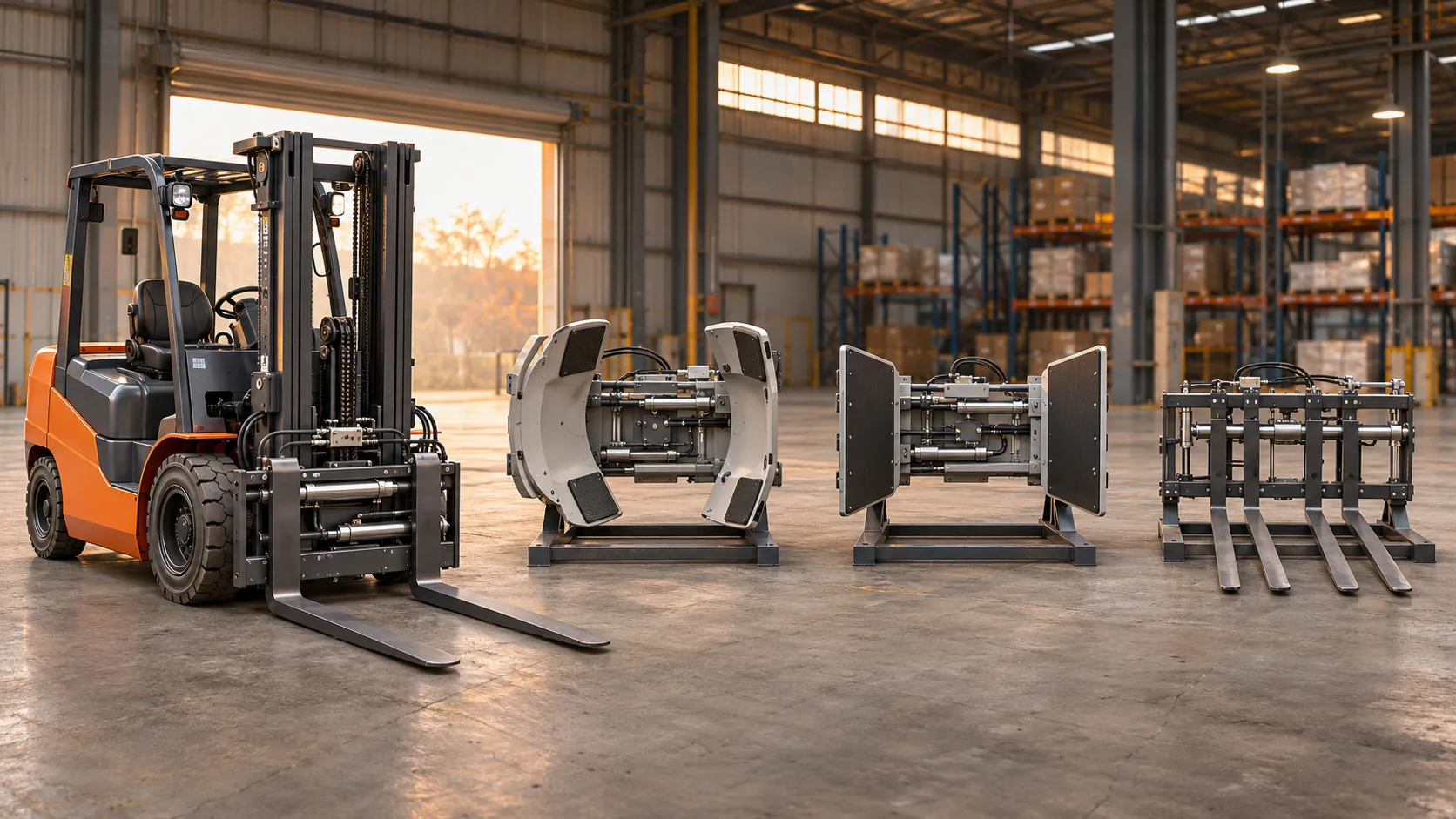
The warehouse manager needs the paper roll clamp for a delivery that lands on Monday. The register says the site has one. The forklift it was last fitted to is in the yard, wearing a standard carriage and a set of forks.
A quick walk round turns up two side-shifts, a fork positioner leaning against the racking and a rotator nobody remembers ordering. The clamp is eventually found at the other site, where it went for “a week or two” last winter. It is still there, and it has not been serviced since it left.
Nobody lost it, exactly. It simply stopped being anyone’s job to know where it was, which is how forklift attachment tracking usually comes apart.
The register usually stops at the truck
Most fleet registers are built around the machine. Each forklift has a fleet number, a serial number, a service history and a home. The attachment fitted to it is often a line in the description, if it appears at all.
That works until the attachment comes off. Clamps, rotators, push-pulls and fork positioners are designed to move between trucks, which is exactly why they drift out of view. The truck stays on the register. The attachment becomes part of the scenery.
When a register only knows about the machine, it cannot answer simple questions: how many clamps do we have, where are they and which one is due for attention?
An attachment has a working life of its own
It is easy to think of an attachment as an accessory, but many of them work harder than the truck they sit on. A clamp grips every load it moves. A side-shift slides back and forth all shift. Hydraulic hoses, cylinders, pads and wear strips all take strain and all wear out.
They also change how the truck behaves. An attachment adds weight and moves the load centre, which affects what the combination can safely lift. That is why it matters which attachment is on which truck, not only that both exist.
Treating attachments as assets in their own right means giving each one an identity, a location and a history, the same way the machines already have.
What a useful attachment record holds
A good attachment record does not need to be complicated. It needs to answer the questions people actually ask when something goes wrong or goes missing:
- What it is, with make, model, serial number and type
- Where it is now and which truck, if any, it is fitted to
- Who it belongs to, especially where hired or customer-owned equipment is involved
- Its service and inspection history, including findings and repairs
- Supporting documents such as manuals, certificates and photographs
With that in place, an attachment stops being “the clamp” and becomes a specific piece of equipment with a story you can follow.
Fitting and removing should leave a trace
The moment an attachment is most likely to disappear is the moment it changes trucks. Somebody needs the side-shift on another machine for a job, it gets swapped over at the end of a shift and the register never hears about it.
The fix is less about technology than habit. When an attachment is fitted, removed or moved to another site, it should be recorded at the time, against the right truck and the right attachment. A short entry is enough: what moved, where it went and who moved it.
Over a few months, those entries build a picture worth having. You can see which attachments are in constant use, which sit idle and which keep travelling between sites because one site is short.
Service attachments on their own schedule
When attachments are only serviced as part of the truck, they tend to be serviced only when they happen to be fitted to the truck on the day. A clamp that spent three months off the truck in a corner of the warehouse may have missed two services and nobody would know.
Attachments with hydraulic functions in particular deserve their own planned maintenance and inspection intervals, with findings recorded against the attachment itself. If a cylinder starts weeping or pads wear thin, that history should follow the clamp to whichever truck it ends up on next.
It also helps when something fails. A technician who can see the attachment’s own repair history will diagnose faster than one guessing from the truck’s record.
Where FMC helps keep attachments in view
FMC was designed with mixed equipment in mind, and attachments sit alongside the machines rather than underneath them.
FMC Asset Management lists attachments among the equipment types it records, with each asset holding its identifiers, location and allocation, documents and photographs, plus a lifecycle history of movements, updates and inspections. FMC QR Intelligence can give each attachment its own scannable identity, so field teams can confirm they are recording work against the right component rather than the truck next to it.
FMC Service Management then keeps planned services, inspections and load tests visible, with completed work and supporting evidence kept on record. The system holds the information; people still need to scan, record and keep the register honest.
A short attachment audit to start with
If attachments have drifted out of view in your operation, a simple audit is a good first step. Walk every site with the register in hand and work through the following:
- Count every attachment on and off the trucks, and compare it with what the register says
- Tag and record anything the register has missed, including the rotator nobody remembers ordering
- Note which truck each attachment is currently fitted to
- Check when each one was last serviced or inspected
- Agree who records a swap or a move between sites, and how
It will not be glamorous work and it will probably turn up a surprise or two. Once it is done, keeping it up to date takes far less effort than the next search.
Then the next time someone asks for the paper roll clamp, the answer will be a location rather than a shrug.
If it can be fitted, moved or lost, it belongs on the register.