
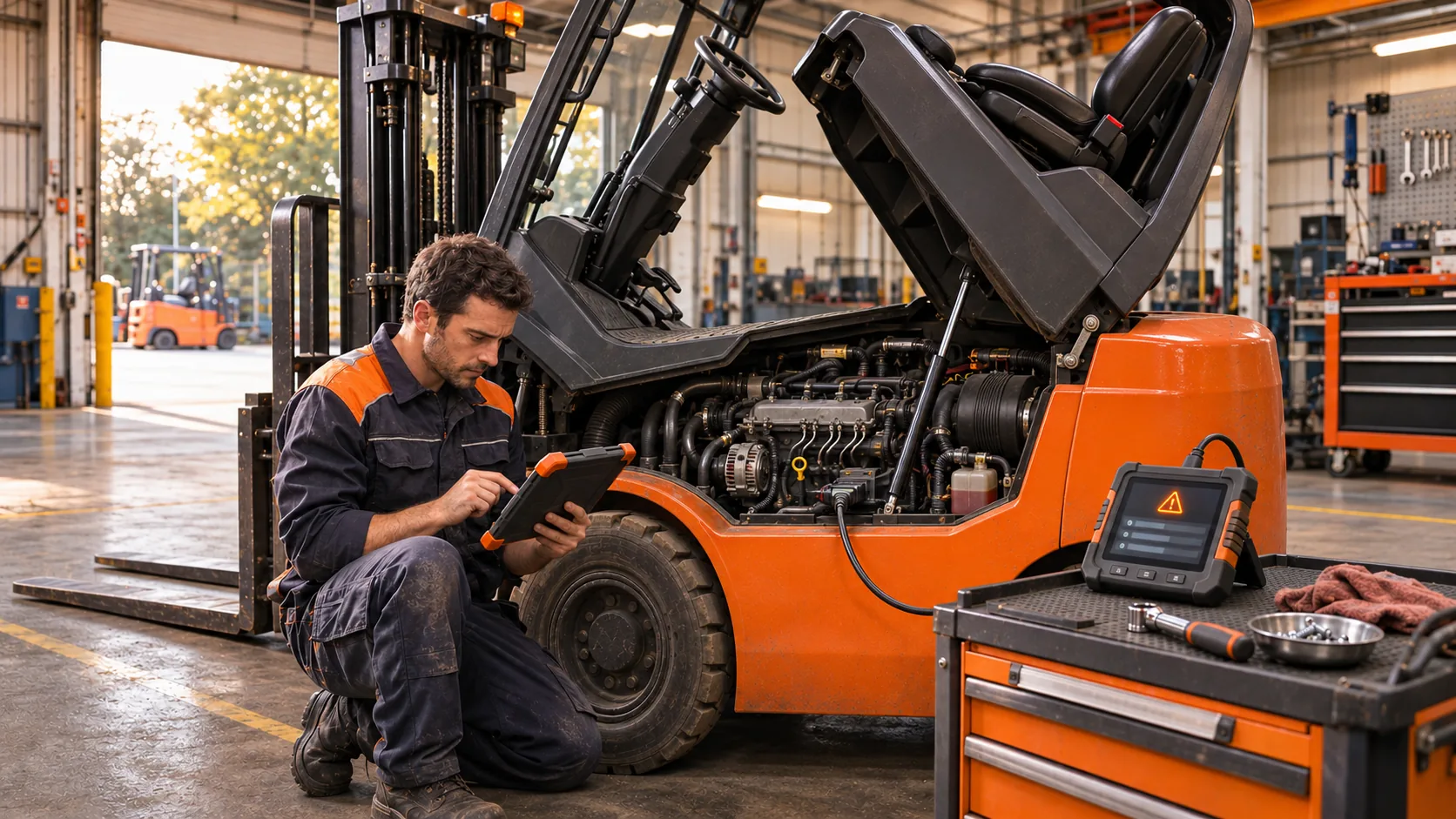
The call comes in just after seven. Reach truck 3 has stopped halfway down aisle 12 and will not lift. The night shift supervisor logs it as “not working”, which is accurate and not especially helpful.
The technician arrives, reads a fault code off the display, finds a loose connector on the lift sensor, reseats it and tests the mast. Ten minutes later the truck is back at work. The job card says “attended, repaired, tested OK”.
Two months later the same truck stops in the same way. A different technician attends. He has no idea what the code was last time, which connector was involved or whether anyone suggested replacing the harness. He starts from the beginning, because the record gives him nowhere else to start.
The repair was good. The record was thin.
Most service teams fix things well. Where they struggle is in writing down what they found in a way that is still useful next time. “Repaired, tested OK” tells the customer the machine is running. It tells nobody why it stopped.
Good forklift fault diagnosis records do not need to be long. They need to answer three questions that every later reader will ask: what was reported, what was actually wrong and what was done about it.
Separate the symptom from the cause
The person who logs a breakdown describes what they can see. “Won’t lift”, “leaking”, “making a noise”. That is the symptom, and it is worth keeping exactly as reported, because it shows how the fault appears to the people using the machine.
The technician’s job is to find the cause. A failed sensor, a worn seal, a damaged cable, a battery that was not charged. When the record keeps symptom and cause in separate places, patterns become far easier to spot. Five “won’t lift” calls might turn out to be three different causes, or one cause turning up in five different ways.
Mixing the two into a single line of free text is how a fleet ends up with plenty of history and very little insight.
Write the fault code down, even when it cleared
Modern machines often display a code when something goes wrong. Technicians read it, act on it and clear it. Then it vanishes, along with one of the most useful facts about the breakdown.
Recording the code as it appeared, before it was cleared, costs a few seconds. It gives the next technician a starting point, and it allows anyone looking at a model across several sites to see whether the same code keeps returning. A photograph of the display does the job nicely and avoids transcription errors at the end of a long shift.
Describe the finding in words someone else can use
Every workshop has its shorthand. “Usual hydraulic issue” makes perfect sense to the person who wrote it and almost none to anyone else. Six months later, it may not even make sense to them.
A useful finding names the component, the condition and the likely reason. “Lift sensor connector loose, pin corrosion visible, harness rubbing on mast channel” is one sentence. It tells the next technician where to look, tells the customer what happened and gives a reliability team something real to work with.
A few agreed fault categories help too, such as hydraulic, electrical, mast, drive, brakes, battery and tyres. They do not replace the description. They simply make it possible to count.
Record what was done, and what was not
The action matters as much as the finding. Was the part replaced, repaired, adjusted or simply reset? Was it a temporary fix to get the machine back into service before a proper repair?
Equally important is what the technician recommended but did not do. If the harness needs replacing and the customer chose to wait, that belongs on the record. It turns a future repeat failure from a surprise into a known item, and it shows that the right advice was given at the time.
“No fault found” is still a finding
Sometimes the technician arrives and the machine works perfectly. It is tempting to close the job with three words and move on.
Intermittent faults are among the hardest to solve precisely because they leave so little trace. A good record notes the conditions at the time, what was tested and any codes stored in the machine’s history. Three “no fault found” visits with careful notes can point to a cause. Three with no notes point only to frustration.
Where FMC helps capture findings on site
FMC is built so that fault information is recorded while the technician is still standing next to the machine, not reconstructed from memory at the end of the week.
The FMC Technician Mobile App is an Android-compatible field tool for capturing attendance, fault findings, photographs, readings, notes, parts and outstanding actions directly from site, with customer sign-off before the job closes. FMC Service Management keeps every breakdown visible from the moment it is raised until its outcome is recorded, with a dependable history of completed work and supporting evidence.
For manufacturers, FMC for OEMs builds a developing record of each machine across its lifecycle, helping identify recurring failures, downtime patterns and trends across models and applications. The diagnosis is still the technician’s skill. FMC makes sure it does not disappear when the job closes.
A practical starting point
You do not need a new process manual to improve fault records. Start with the next ten breakdown jobs and agree a short standard:
- Keep the symptom exactly as it was reported
- Record any fault code before it is cleared, with a photograph of the display if possible
- Name the component, its condition and the likely cause in one clear sentence
- Choose one fault category from a short agreed list
- Note the action taken and whether it was permanent or temporary
- Write down any recommended work that was not done, and why
Then read those ten records as if you were the next technician to attend. If they tell you where to look and what was tried, the standard is working. If they do not, adjust it before the next ten.
Back in aisle 12, the second visit goes differently when the first record is good. The technician sees the code, the connector and the note about the harness. He replaces the harness, and reach truck 3 stops making the morning call list.
Fix the machine once, and write it down well enough that nobody has to fix it twice.