The job card said “Reach truck, fleet no. 7, cold store”. The technician found three reach trucks parked nose to tail outside the cold store doors. They were the same make and colour, and all three fleet numbers had been painted over during a refurbishment two years earlier.
The serial plate on the first one was frosted over. The plate on the second was readable, just, with a torch and some squinting. The shift supervisor was fairly sure it was the one on the left. Or possibly the middle one. “The one that makes the noise,” he offered helpfully.
The technician serviced the one that made the noise. The work was done well. It was recorded against the machine on the left.
A wrong record is worse than a missing one
Nobody in that story was careless. The work was real, the job card was signed and the customer was satisfied. The problem only surfaces later, once the histories of two machines have quietly swapped places.
Three months on, the truck on the left appears to have had a full service and a new mast chain. The truck in the middle appears to have been neglected. When the middle one breaks down, the conversation starts from a record that is confidently wrong.
That is the uncomfortable thing about asset identification. Missing information is at least obviously missing. Information captured against the wrong machine looks perfectly trustworthy until someone relies on it.
Fleets are full of look-alikes
Materials handling operations are very good at buying in batches. A site might run ten counterbalance trucks of the same model, a row of identical pallet stackers and a battery room where every battery looks exactly like its neighbour. Add chargers, attachments and the odd rental unit, and identification becomes a genuine skill.
Serial plates were never designed for quick reading in a dim aisle. They fade, get painted over, sit behind guards or end up in the one spot nobody can reach without lying on the floor. Fleet numbers help until a machine is renumbered, transferred or replaced by a hire unit with a temporary sticker.
Then there is equipment that moves. Batteries swap between trucks. Machines transfer between branches. A forklift that started the year in one warehouse may finish it at a customer’s site across town. Every move is another chance for the physical machine and its record to drift apart.
Searching long lists slows everyone down
When identification depends on memory and lists, field teams fill the gap the only way they can. They scroll through an asset list on a phone, choose between two similar entries or write “RT, cold store” and promise to sort it out back at the office.
Some do sort it out. Others are already on their way to the next breakdown. By Friday, the admin team is matching job cards to machines like a jigsaw with a few pieces from a different box.
This is not a technician problem. It is a process problem. If confirming the right asset takes five minutes, people will reasonably look for a quicker way, and the quicker way is usually a guess.
One scannable identity for every asset
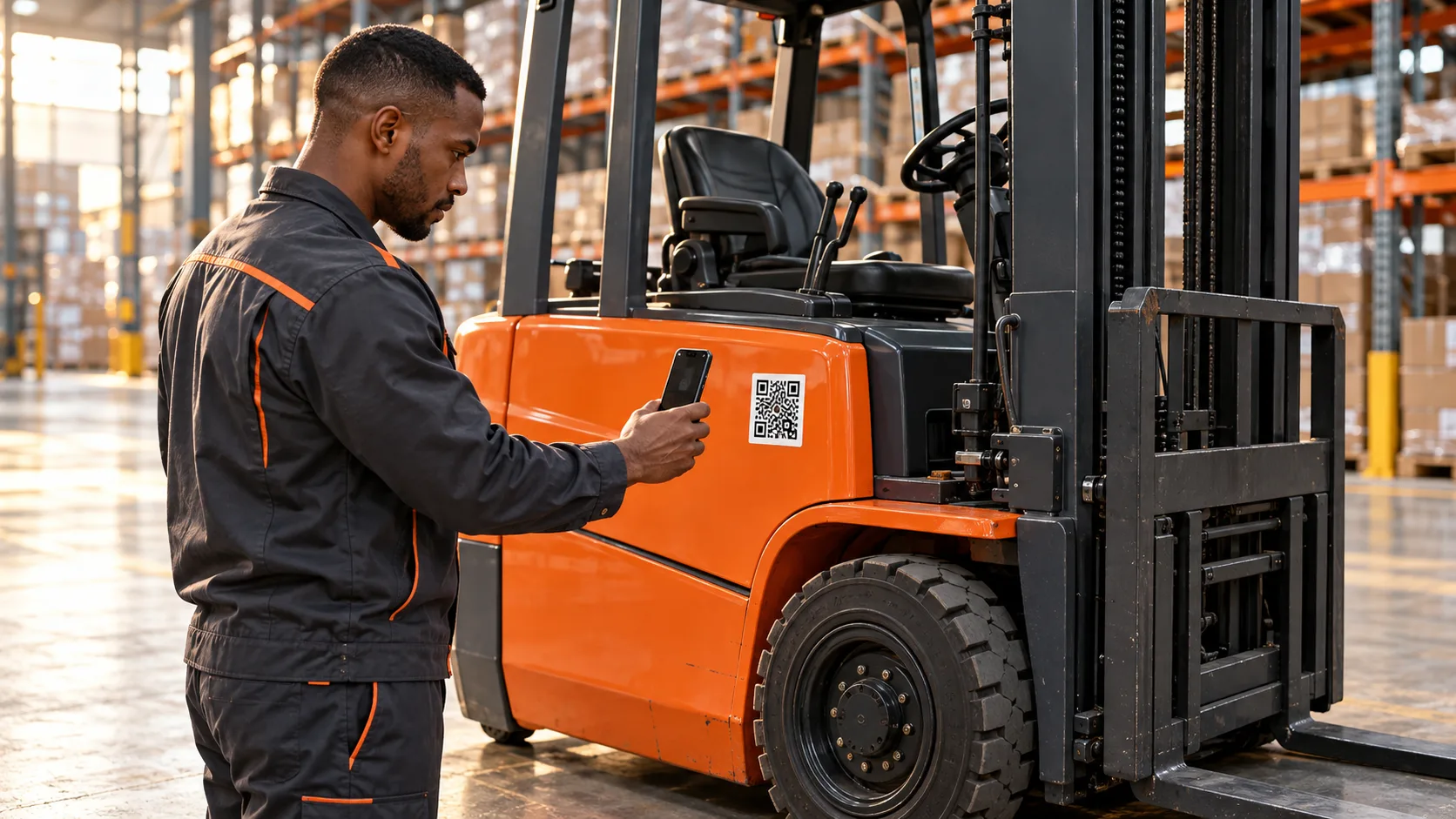
QR code asset tracking solves a narrow problem very well. Each trackable asset carries its own code, and scanning it opens that asset’s record. It does not depend on reading a serial plate, remembering a fleet number or knowing which truck makes the noise.
The value lies less in the technology than in certainty at the point of work. The technician confirms the machine in front of them before recording an inspection, a reading or a repair. The record starts in the right place, so everything added to it stays in the right place.
It works best when it is applied consistently. One identification standard across forklifts, reach trucks, stackers, batteries, chargers and attachments means nobody has to remember which equipment type uses which method. Mixed fleets, mixed brands and mixed ownership can all follow the same rule.
A label is a routine, not a sticker
A QR label is only as useful as the habits around it. A few practical ones make a real difference:
- Place labels where they can be scanned safely and easily, not behind a guard or somewhere they will be caked in grime within a week.
- Label new and returning equipment before it goes into service, including rental units and replacement batteries.
- Treat a damaged or missing label as a defect to report, just like a broken light.
- Make scanning the first step of every job, not an optional extra for when there is time.
The aim is simple: the first thing anyone does at a machine is confirm which machine it is.
Where FMC supports reliable asset identification
FMC QR Intelligence gives every trackable asset its own scannable identity, from forklifts, reach trucks and order pickers to batteries, chargers, attachments and supporting equipment, regardless of make, model, ownership or operating site. A quick scan helps authorised users confirm the equipment in front of them and reach the relevant asset information without searching long lists or faded serial plates.
That identification carries through into field work. With the FMC Technician Mobile App, an Android-compatible field tool, technicians can record inspections, readings, photographs, work completed, parts and customer sign-off while they are still on site. For service providers working across many customers and sites, that helps reduce activity captured against the wrong machine and builds a more dependable history for every asset.
A scan confirms the asset. Teams remain responsible for doing the work properly and recording it accurately.
Where to start this week
Pick one site and one equipment type, then test how identification really works:
- Ask a technician to identify five machines from the asset list without help. How long does it take?
- Compare last month’s service records with the machines physically on site. Do any histories look suspiciously quiet or suspiciously busy?
- Check how batteries and chargers are identified. Could anyone tell two of them apart from the record alone?
- Find out what happens when a hire unit arrives. Who gives it an identity, and when?
- Count how many job cards were corrected afterwards because of a wrong fleet number or serial.
If the honest answer to most of these is “it depends who’s on shift”, identification is relying on memory rather than method.
Every good record starts with the right machine.