
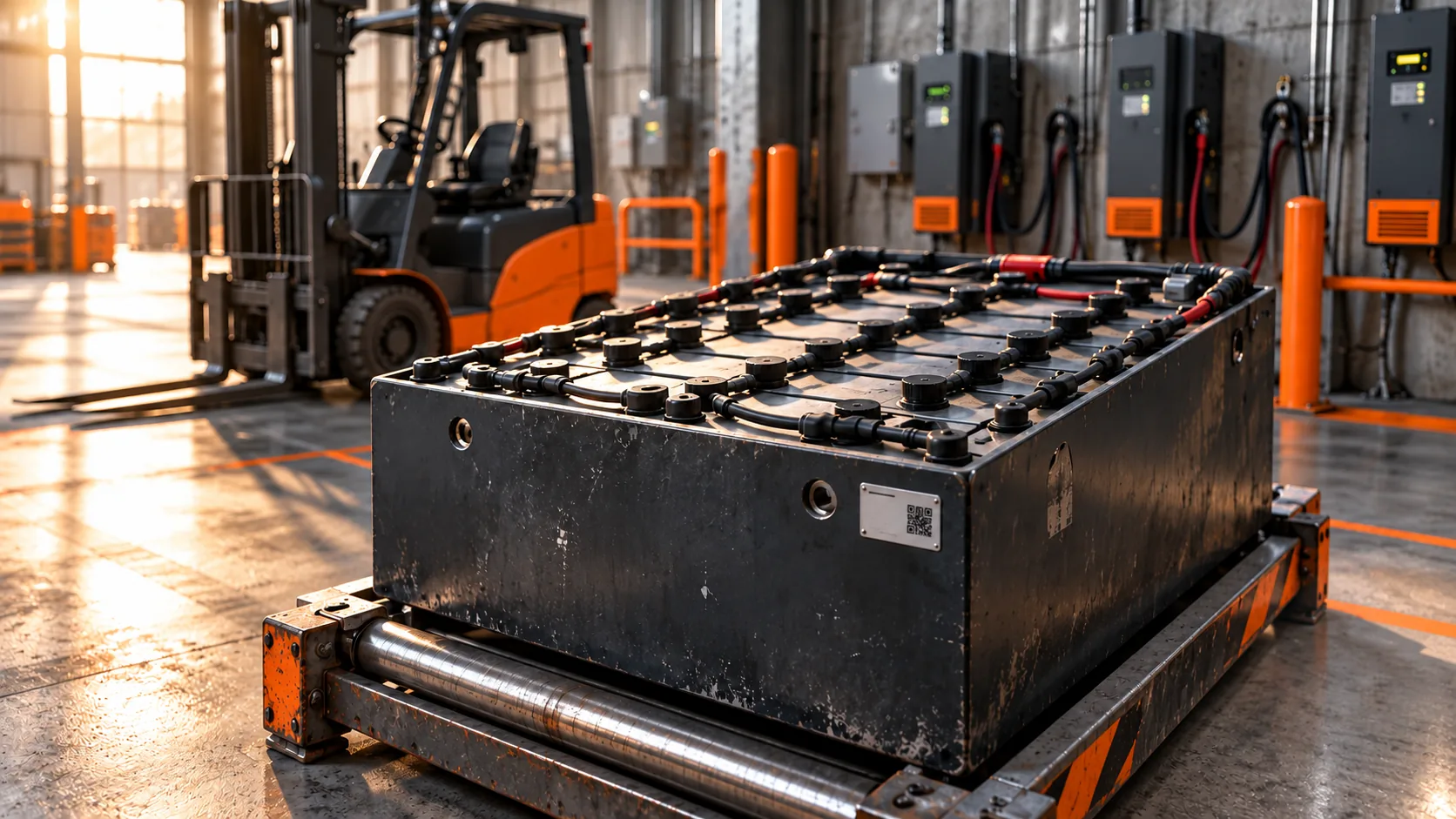
“Which battery is in truck 14?”
“The one that came back from the other site, I think.”
“Has anyone checked it since?”
On most warehouse floors, each forklift has a fleet number, a service history and someone who knows roughly when it was last looked at. The battery under the seat often has none of these. Or rather, it has them somewhere: on a charger card, in a technician’s notebook or in a spreadsheet tab nobody has opened since the last audit.
That is a curious arrangement. On an electric forklift, the traction battery is often one of the most expensive components on the machine, yet it is frequently managed as an accessory to the truck rather than as an asset in its own right.
Good forklift battery management starts by changing that view.
A battery is an asset, not an accessory
Batteries move. They are swapped between machines to keep shifts running, transferred to another site when demand changes and sent away for repair before returning to service. Each move makes sense at the time. Together, they make it surprisingly hard to say which battery has been where, in which machine and under whose care.
When records follow the truck instead of the battery, history attaches itself to the wrong thing. A problem logged against a forklift may really belong to the battery that was fitted that week. When the battery moves on, the problem goes with it, and the paperwork stays behind.
Treating each battery and charger as a separately identified asset is the foundation. It needs its own reference, its own specifications, its own location and its own story.
Identity should be confirmed at the battery, not remembered afterwards
Batteries in a charging bay can look remarkably alike. Serial plates get dirty, labels fade and “the second one from the left” is not an asset number.
If readings are recorded against the wrong unit, the record is arguably worse than having none. It looks dependable while describing a different battery. Decisions about maintenance, warranty conversations and replacement planning then rest on someone else’s history.
The practical answer is to confirm identity at the point of work, before anything is recorded. A technician standing next to the battery is far better placed to get this right than an administrator reconciling notes at the end of the week.
Routine care only counts if it is recorded
Much of battery maintenance is routine: inspections, readings, cleaning, watering and checking for damage. Routine work is exactly the kind that gets done and never written down, or written down somewhere separate from everything else.
The gap becomes obvious when a battery starts underperforming. Was it looked after and simply nearing the end of its working life? Or were inspections missed for months? Without a consistent record, the honest answer is often “we’re not sure”.
A structured inspection record captures what was checked, what was found, who did the work and when. Photographs and noted findings add context. Over time, the record also shows what was not done, which is often the more useful information.
Chargers deserve a record of their own
A battery spends a large part of its life connected to a charger, yet chargers are easily forgotten until one stops working. They are moved between bays, borrowed by another site or paired with whichever battery happens to be nearby.
Giving chargers their own identity, location and service history makes it easier to separate a battery issue from a charging issue. It also means that when a charger is repaired or relocated, that event is recorded instead of being passed on by word of mouth.
Movement is where the trail usually goes cold
For a single site, losing track of a battery is inconvenient. For a battery company looking after batteries across many customers and sites, it becomes a commercial problem. The same is true for fleet operators running several sites, where batteries are shared, swapped and occasionally “borrowed” without much ceremony.
Each movement should leave a trace: which customer, which site, which machine and from when. With that in place, three questions become easy to answer. Where is this battery now? Where has it been? Who is responsible for it at its current location?
Without it, a periodic stock count turns into a search party.
Repair, rotate or replace: decisions need history
Sooner or later, every battery reaches a decision point. Repair it, move it to lighter duty or replace it?
Without history, that decision tends to rest on the most recent complaint or the most confident opinion in the room. With a dependable record of inspections, condition findings, repairs and movements, the conversation becomes far more grounded. Repeat findings stand out. Past repairs are visible. The battery’s working life can be judged on evidence.
When a battery is eventually replaced, its record should not disappear with it. That history is useful for understanding how similar batteries perform in similar applications, and for planning the next replacement with fewer surprises.
Where FMC supports battery management
FMC Battery Management gives every battery and charger its own digital identity. QR scanning allows authorised users to confirm they have the correct battery before recording inspections, readings or service activity, whether the asset is a lead-acid battery, a lithium-ion unit or a charger.
Inspections, condition findings, photographs, maintenance, repairs and movements between equipment, sites and customers build one history that stays with the battery, from registration through to replacement. Technicians capture that work in the field on the FMC Technician Mobile App. For battery companies, battery populations can be organised by customer, site and equipment from one central platform.
The record is only as good as the routine behind it. Someone still has to tag the batteries, agree inspection standards and act on what the information shows. FMC keeps the history connected; people keep the batteries healthy.
Start with one site and a simple count
A practical first step is to choose one site and list every battery and charger. For each one, ask four questions. Can it be identified reliably? Where is it allocated? When was it last inspected and by whom? Is any work outstanding?
The gaps in those answers show where to begin. If several answers start with “we’d have to ask the night shift”, that is useful information too.
A forklift cannot tell you which battery it had last Tuesday. Your records should.