
How Independent Fleet Dashboards Improve Forklift Uptime and Operational Control

Forklift fleets are among the most critical — and least visible — operational assets in warehousing, manufacturing, logistics, and distribution environments. Despite their importance, many businesses still manage forklifts through fragmented reports, supplier portals, spreadsheets, and reactive communication. The result is a lack of clarity around uptime, cost, compliance, and performance.
Independent fleet dashboards are changing this. By consolidating real-time data across all forklift brands, sites, and suppliers, these platforms give businesses operational control they have never truly had before. Rather than relying on supplier feedback or delayed reports, decision-makers gain immediate visibility into what is happening on the floor — and why.
This article explains what an independent forklift fleet dashboard is, how it differs from supplier systems, and how it directly improves uptime, cost control, compliance, and strategic decision-making.

Why Forklift Visibility Has Traditionally Been So Poor
Forklift fleets often grow organically. A few units are purchased, others are leased, rentals are added during peak periods, and different suppliers are introduced as operations expand. Over time, this creates a fragmented environment where information is spread across:
- Multiple supplier portals
- Email communication with service providers
- Manual service logs
- Invoices reviewed after the fact
In this model, visibility is retrospective. Managers only learn about problems once downtime has already occurred, costs have already been incurred, or compliance gaps have already formed.
Without central visibility, forklift management becomes reactive by default.
What Is an Independent Forklift Fleet Dashboard?
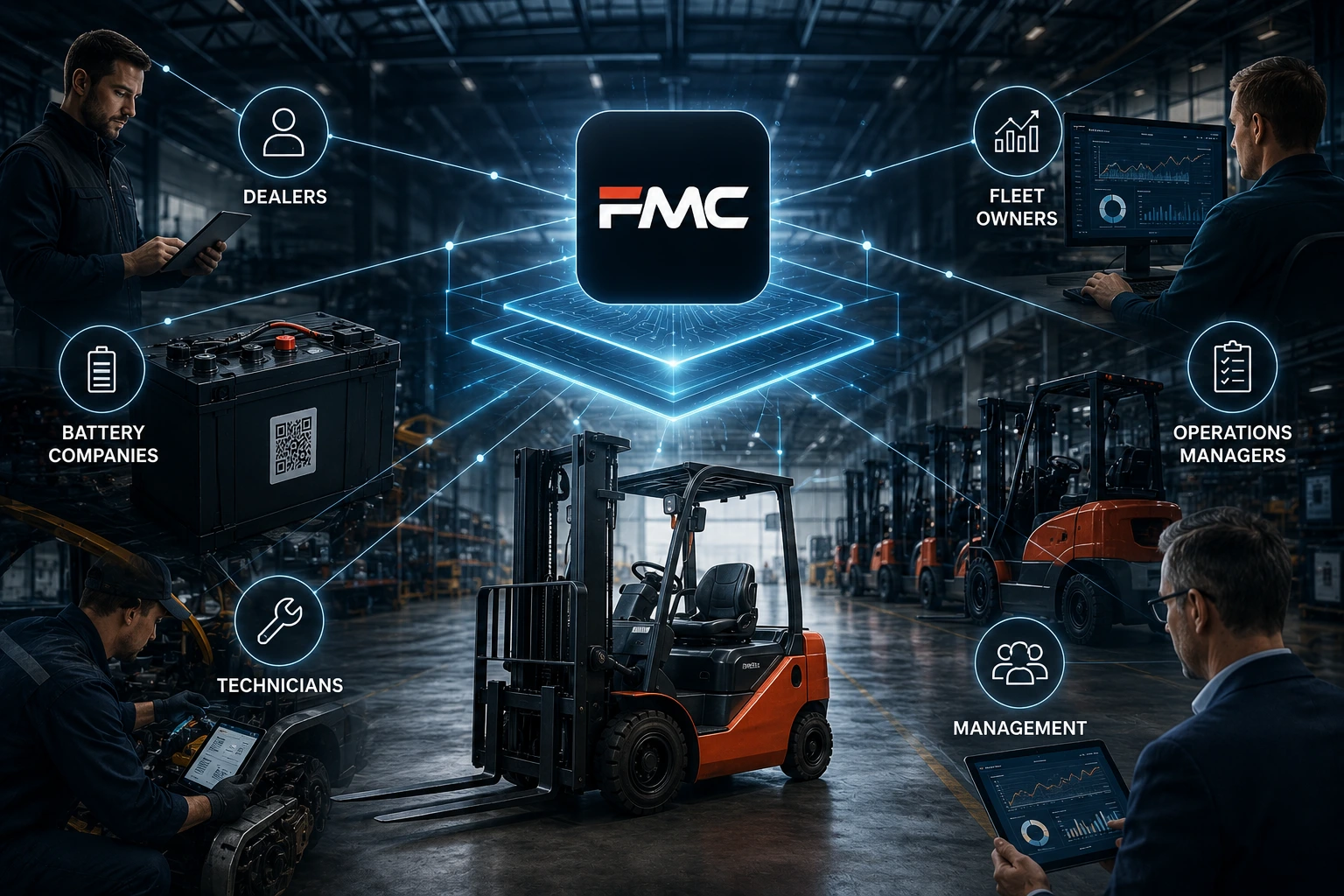
An independent forklift fleet dashboard is a supplier-neutral, centralised platform that aggregates operational, maintenance, compliance, and cost data across an entire fleet.
Unlike supplier portals — which only show information related to that supplier’s equipment — an independent dashboard provides a single source of truth for:
- All forklift brands
- All sites and locations
- All service providers
- All contract types (owned, leased, rental)
This independence is critical. It removes bias, prevents data silos, and enables objective decision-making.
Core Functions of an Independent Fleet Dashboard
While dashboards vary by platform, effective systems typically include:
1. Real-Time Fleet Status
Managers can instantly see:
- Which forklifts are operational
- Which are down
- Where downtime is occurring
- How long units have been unavailable
This alone represents a major shift from reactive reporting to proactive oversight.
2. Centralised Service Call Tracking
All service requests are logged, tracked, and timestamped in one place. This allows:
- SLA response and repair times to be measured
- Escalations to be managed objectively
- Repeat failures to be identified
- Instead of chasing updates, managers see service progress in real time.
3. Uptime and Downtime Analytics
Dashboards convert raw data into meaningful insights, such as:
- Uptime percentage per forklift
- Downtime trends by site or supplier
- Cost per hour of operation
- Mean time between failures
These metrics are essential for understanding true fleet performance.
4. Compliance and Safety Tracking
Compliance documentation — often scattered across emails and files — is centralised. Dashboards can track:
- Inspection status
- Load test expiry dates
- Operator training records
- Outstanding safety actions
This reduces audit risk and ensures compliance does not rely on memory or manual checks.
5. Cost and Usage Visibility
Instead of reviewing costs after invoices are processed, dashboards allow:
- Live tracking of maintenance spend
- Comparison of cost by forklift or site
- Identification of high-cost assets
This visibility supports better budgeting and procurement decisions.

How Dashboards Directly Improve Forklift Uptime
Forklift uptime is not only about maintenance quality — it is about response speed, prioritisation, and accountability.
Independent dashboards improve uptime in several key ways.
Early Issue Identification
Patterns emerge quickly when data is centralised. Repeated call-outs, long repair times, or specific components failing across multiple units become visible early — allowing intervention before widespread downtime occurs.
Faster Escalation and Resolution
When service delays are visible in real time, escalation becomes factual rather than emotional. Managers can act immediately, rather than discovering delays days later.
Accountability Through Measurement
Service providers perform differently when performance is measured objectively. Dashboards enable:
- SLA enforcement
- Performance benchmarking
- Data-backed discussions
This alone often leads to measurable uptime improvements.
Operational Control Beyond Maintenance
Independent dashboards are not maintenance tools — they are management tools.
They enable leaders to answer questions such as:
- Do we have the right number of forklifts?
- Are we over-renting during normal operations?
- Which sites experience the most downtime — and why?
- Which forklifts should be replaced, redeployed, or removed?
Without consolidated data, these decisions rely on assumptions.
Reducing Cost Without Reducing Capability
One of the most valuable outcomes of dashboard visibility is cost reduction without compromising operations.
Common cost savings identified through dashboards include:
- Removing underutilised rental units
- Identifying forklifts costing more to maintain than replace
- Avoiding unnecessary fleet expansion
- Reducing overtime caused by downtime
These savings are structural, not short-term cuts.
Dashboards and Compliance: Reducing Risk Proactively
Compliance failures often occur not because businesses ignore safety, but because information is fragmented.
Dashboards reduce compliance risk by:
- Flagging expiring certificates automatically
- Highlighting missing inspection records
- Providing audit-ready documentation
This proactive approach reduces legal exposure and insurance risk.
Multi-Site Operations: Where Dashboards Deliver the Most Value
The larger and more geographically dispersed an operation becomes, the more valuable central visibility is.
For multi-site businesses, dashboards:
- Standardise reporting across locations
- Highlight site-specific inefficiencies
- Enable head-office oversight without micromanagement
This balance is difficult to achieve through manual systems.
Why Supplier Dashboards Are Not Enough
Many suppliers offer dashboards — but these are limited by design.
Supplier dashboards:
- Only show their own equipment
- Do not benchmark performance objectively
- Cannot compare across suppliers
- Prioritise service delivery, not fleet optimisation
Independent dashboards fill this gap by putting the business, not the supplier, in control.
Using Dashboard Data for Strategic Decisions
Beyond day-to-day management, dashboards support long-term strategy.
They inform:
- Lease vs rent vs buy decisions
- Supplier contract negotiations
- Fleet standardisation initiatives
- Capital planning and budgeting
Data replaces opinion, leading to better outcomes.
Technology as an Enabler, Not the Solution
It is important to note that dashboards alone do not fix problems. Value comes from:
- Interpreting the data correctly
- Acting on insights
- Integrating data into management processes
This is where independent fleet management and consulting adds value.
The Role of Independent Oversight
Independent oversight ensures dashboards are used objectively. It prevents data from becoming another ignored reporting tool.
With the right governance:
- Data drives action
- Suppliers are managed fairly
- Decisions align with business objectives
This combination of technology and independence is where real transformation occurs.
Conclusion: From Reactive Oversight to True Fleet Control
Independent forklift fleet dashboards fundamentally change how businesses manage materials handling equipment. By providing real-time visibility, objective performance data, and centralised control, they eliminate guesswork and reactive decision-making.
For businesses seeking higher uptime, stronger compliance, and lower total fleet cost, dashboards are no longer optional — they are essential.
The difference lies not in having data, but in who controls it.