Why FMC Is Becoming Critical in the Logistics Industry

In logistics, control is everything, from inventory and transport to labour, throughput, and delivery windows, or at least that’s the goal. But there’s one critical area most companies don’t truly control: their forklift fleet. And that’s where the gap lies.
Every logistics operation depends on forklifts.
Without them:
- Pallets don’t move
- Trucks don’t load
- Picking slows down
- Dispatch stalls
Forklifts are not support equipment.
They are production assets.
Yet, in most logistics environments, they are:
- Managed reactively
- Overseen by multiple suppliers
- Tracked manually
- Measured inconsistently
Which creates a dangerous situation:
A critical operational asset… without central control.

Why Traditional Fleet Management Falls Short
Historically, logistics companies have relied on:
- Service providers
- Rental partners
- Internal spreadsheets
- Site-level management
Each plays a role.
But none provide:
- Full visibility
- Independent oversight
- Cross-site consistency
- Performance accountability
This leads to fragmented management where:
Each site operates differently
Each supplier reports differently
Each problem is handled in isolation
There is no unified view.
And without a unified view — there is no real control.
The Real Risk: Not Breakdown — Blindness
Most businesses believe the biggest risk is:
“What happens when a forklift breaks down?”
It’s not.
The real risk is:
Not knowing how often it breaks down, how long it stays down, and what it’s costing you.
Because logistics teams are excellent at adapting:
- Machines are shared
- Work is reprioritised
- Overtime is used
- Manual work increases
The operation continues.
But:
Efficiency drops
Cost increases
Pressure builds
And none of it is clearly measured.
What We’ve Learned from Real Operations
When we step into logistics environments, we don’t usually find broken systems.
We find working systems with invisible inefficiencies.
- Forklifts are being serviced — but not optimised
- Breakdowns are being handled — but not analysed
- Technicians are active — but not measured
- Costs are tracked — but not understood
Everything is happening.
But very little is connected.
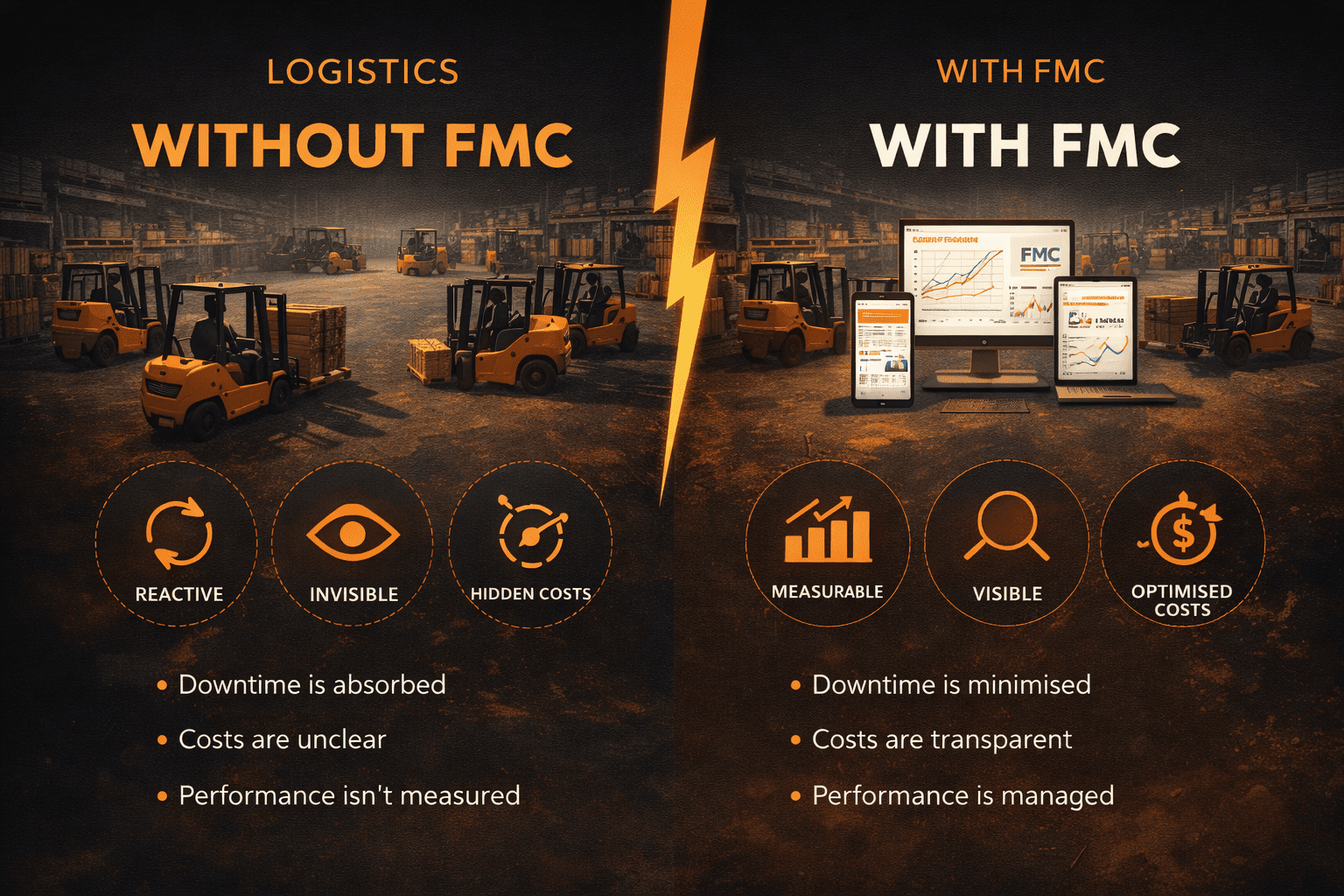
Why FMC Changes the Game
FMC introduces something the logistics industry has traditionally lacked:
Independent, centralised fleet control.
Not from a supplier perspective.
Not from a maintenance perspective.
From a management and performance perspective.
1. From Fragmented Data to One Source of Truth
Instead of:
Emails
Spreadsheets
Supplier portals
FMC centralises:
Fleet data
Service events
Downtime tracking
Compliance records
Cost visibility
Across:
All sites
All suppliers
All assets
This creates a single, reliable view of the fleet.
2. From Assumed Uptime to Measured Uptime
Without FMC:
“We think uptime is good.”
With FMC:
“We know exactly where uptime is lost — and why.”
This includes:
Downtime per machine
Frequency of breakdowns
Duration of service events
Impact on operations
Uptime becomes measurable — and therefore manageable.
3. From Reactive Service to Performance Management
Service providers don’t change —
but how they are managed does.
FMC introduces:
SLA tracking
Response time visibility
Repair duration tracking
Performance benchmarking
This shifts service from:
Activity-based
to
Performance-based
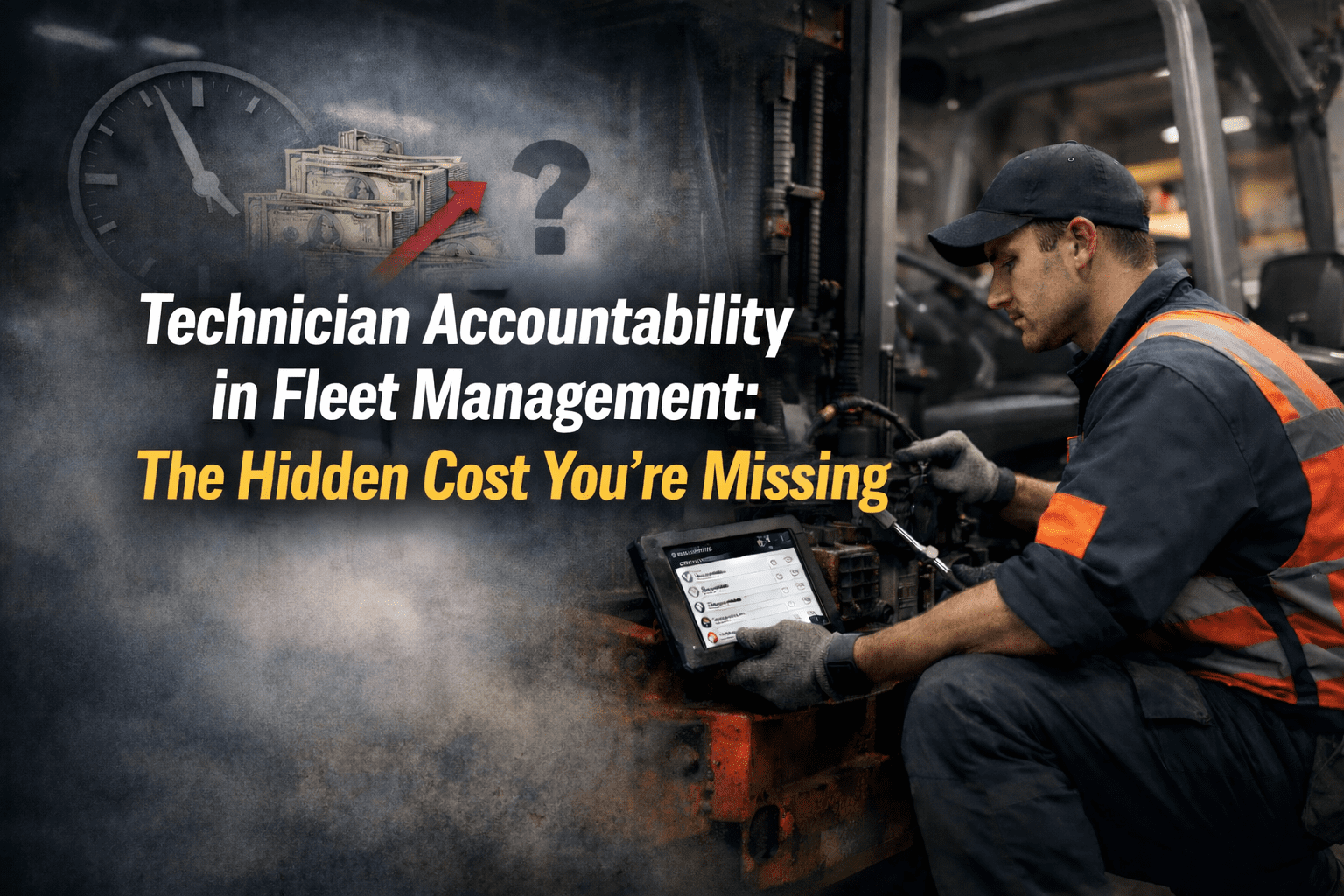
4. From Technician Activity to Technician Accountability
Technicians are often busy — but not always optimised.
FMC provides visibility into:
Job allocation
Time on site
Repeat failures
Rework trends
Overtime patterns
This removes guesswork and introduces:
Accountability
Efficiency
Continuous improvement
5. From Compliance Risk to Compliance Control
In logistics, compliance is non-negotiable.
Yet many businesses rely on:
Manual tracking
Site-level discipline
Supplier updates
FMC centralises:
Load tests
Service intervals
Inspection records
Compliance status
This ensures:
Nothing expires unnoticed
Audits are straightforward
Risk is reduced
The Multi-Site Advantage
For logistics companies operating across multiple sites, FMC becomes even more critical.
It allows:
- Standardised reporting
- Cross-site comparison
- Central oversight
- Consistent performance measurement
Head office moves from:
“Receiving reports”
To:
Actively managing performance.
Why FMC Is No Longer Optional
The logistics industry is becoming:
Faster
More competitive
More data-driven
More cost-sensitive
Margins are tightening.
Customer expectations are rising.
In this environment:
Hidden inefficiencies matter
Unmeasured downtime matters
Lack of visibility matters
FMC is not an operational tool.
It is a control layer.
And without it, logistics companies are:
Operating partially blind
Managing reactively
Leaving efficiency on the table
Final Thought
Logistics companies don’t have a forklift problem.
They have a visibility problem.
And once visibility is solved:
- Uptime improves
- Costs reduce
- Performance stabilises
- Decisions become strategic
The question is no longer:
“Do we need better forklifts?”
It’s:
“Do we have control over the ones we already have?”